Sidewalks, Streetlights, and Sightlines: What Street Design Tells You Before You Ever Step Inside a Home
Most buyers arrive at a property focused on square footage, kitchen finishes, and basement potential. Few arrive thinking about the width of the sidewalk or the spacing of the streetlights. Yet those seemingly minor infrastructure details quietly determine whether a block feels safe enough to raise children, walk the dog after dark, or let a teenager ride a bicycle to a friend's house. Street design is one of the most underexamined variables in residential real estate — and one of the most predictive.
At 119 Woods Drive, we believe that a home's value is inseparable from the street it sits on. Understanding how physical design shapes perceived safety — and actual safety — is a skill every serious buyer should develop before making an offer.
Why Street Design Is a Safety Signal, Not Just an Aesthetic One
Urban planners and transportation engineers have long understood that the physical configuration of a street shapes human behavior. Streets with narrow sidewalks, poor lighting, and wide travel lanes designed for high-speed traffic create environments where pedestrians feel exposed and vulnerable. Families with young children are particularly sensitive to these conditions, often making housing decisions based on whether a block feels manageable on foot rather than by car alone.
The research on this is consistent. Neighborhoods with well-maintained, adequately wide sidewalks — typically five feet or more to allow two adults to walk side by side — report higher rates of pedestrian activity. Higher pedestrian activity correlates with what urban researchers call "natural surveillance," the informal but powerful sense that people are watching out for one another simply by being present outdoors. Streets that feel empty, by contrast, tend to stay empty, which compounds over time into a perception of neglect that is difficult to reverse.
For a buyer evaluating a property, this is not abstract theory. It is a practical framework for predicting whether a block will hold its appeal to families — the most stable and demand-consistent segment of the residential market — over a five, ten, or twenty-year horizon.
What to Evaluate on Every Property Tour
The property tour typically begins the moment you park your car. Before you walk through the front door, take ten minutes to assess the street itself. Here is what to examine:
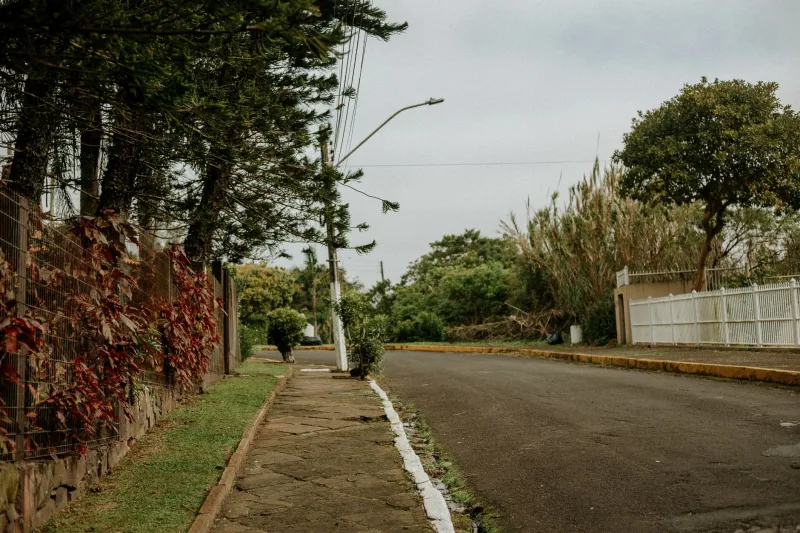
Sidewalk continuity and condition. Does the sidewalk run the full length of the block without interruption? Are there gaps where driveways cut across the path without clear pedestrian markings? Cracked, uneven, or absent sidewalks are not merely inconvenient — they signal that pedestrian access was not a priority when the street was designed or maintained. Blocks where sidewalks disappear entirely force residents into the roadway, a condition that reliably discourages foot traffic and reduces the block's appeal to families with strollers or young children on bikes.
Street lighting coverage. Visit the street after dark if at all possible, or at minimum during the evening hours of a winter property tour. Adequate lighting means fixtures spaced closely enough that pools of light overlap, eliminating dark stretches between poles. Streets with inconsistent or sparse lighting create zones of visual uncertainty that most pedestrians — and most parents — instinctively avoid. Poor lighting also correlates with higher rates of property crime, a relationship that insurers and law enforcement agencies have documented extensively.
Intersection visibility and design. Stand at the nearest intersection and observe how easily drivers can see pedestrians approaching from all directions. Overgrown hedges, parked cars positioned too close to corners, and poorly designed curb radii all reduce sightlines in ways that increase the risk of pedestrian-vehicle conflicts. Well-designed intersections often include curb extensions, also called "bump-outs," that shorten the crossing distance and bring pedestrians into clearer view of oncoming traffic. Their presence on a block is a positive indicator of thoughtful municipal investment.
Traffic calming features. Speed humps, raised crosswalks, chicanes, and narrowed travel lanes are not nuisances — they are deliberate infrastructure investments that municipalities make when they want to slow vehicle speeds and prioritize resident safety. Streets that include these features typically see lower traffic speeds, fewer pedestrian injuries, and higher rates of outdoor activity among children. Their absence on a busy residential block, particularly one near a school or park, is worth noting as a potential concern.
Lane width and traffic volume. Wide lanes encourage faster driving. Streets designed with travel lanes of thirteen or fourteen feet — wider than most highway lanes — implicitly signal to drivers that speed is acceptable, regardless of posted limits. Residential streets with appropriately narrow lanes of ten to eleven feet naturally slow traffic through what engineers call "self-enforcement." When evaluating a block, pay attention to whether the street feels scaled for people or for vehicles.
The Case of the Comparable Block That Couldn't Compete
Consider a scenario that plays out in many metropolitan markets. Two blocks in the same zip code carry nearly identical listing prices. The homes are similarly sized, similarly updated, and similarly positioned relative to schools and shopping. Yet one block consistently sells faster and at higher final prices than the other.
The difference is frequently traceable to street design. The higher-performing block may have wider sidewalks, mature trees that create a canopy effect and further slow traffic, pedestrian-scale lighting, and a traffic circle at the nearest intersection. The underperforming block may have no sidewalks at all on one side, a straight, wide roadway that functions as a cut-through for commuters, and lighting fixtures spaced far enough apart that portions of the street are genuinely dark after sunset.
Families touring both blocks feel the difference immediately, even if they cannot articulate it in technical terms. The well-designed block feels like a place where children can exist safely outdoors. The other block does not. That perception — grounded in real design differences — drives purchasing decisions and, over time, drives price divergence between streets that appear otherwise equivalent on paper.
What Buyers Can Reasonably Expect to Change
It is worth being realistic about the limits of individual influence over street design. A homeowner cannot unilaterally widen a sidewalk or reposition a streetlight. What buyers can do is advocate through neighborhood associations and municipal channels — and many successful street redesign projects have originated with organized resident campaigns. Some municipalities offer traffic calming programs that residents can formally request.
More immediately, buyers should factor existing design conditions into their long-term value assessment. A block with well-established design features is likely to retain its family appeal. A block with significant design deficiencies carries a risk premium that listing prices do not always reflect.
Reading the Street Before You Read the Listing
At 119 Woods Drive, we encourage buyers to treat the street itself as part of the property they are evaluating. A well-designed street is not a bonus — it is infrastructure that supports daily life, neighborhood cohesion, and long-term value in ways that interior upgrades simply cannot replicate.
The next time you schedule a property tour, arrive a few minutes early. Walk the block. Cross the street. Stand at the corner. Notice what the street asks of the people who live on it. That information belongs in your decision-making process just as much as the inspection report or the comparable sales analysis. In many cases, it will tell you more.